This is a cooperative effort of our period 3 class to document what occurs in class on a daily basis. This is "our book", written by us, for us (and for whomever else stops by). Each day, one student is the "scribe". Before the next class, that student "adds a post" in which he/she explains what happened in class. Concepts must be explained and documented. Examples, diagrams, graphs, scanned worksheets, links, photos or videos (taken with a camera or cell phone) can be included.
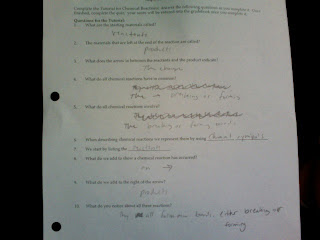
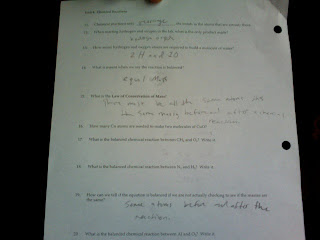
This Friday we got our Unit 3 tests and our first quarter grades. We went over the test and then Mr. Henderson explained to us that the computer took off three of our worst webassign homework grades. There seemed to have been a problem, so he said that he would fix it once we went to the science computer lab. Once we got into the science computer lab we had to get with our qroups and exchange our information and work for the flight crash problems. Mr. Henderson said that if groups finished early they could start on the homework which was a Chemthink on chemical reactions. First we had to look at the tutorial to get the idea of the subject. Then we had to take a quiz on the material we just learned. You could only get 2 wrong. If you got three wrong you had to start over. mr. Henderson also told us a bout a work sheet on the back of the new packet that would be due with the Chemthink. The page has a front and a back side to it. An easy way to get it done would be, going through the tutorial and writing in the answers as you follow.
The basics of what we will be learning about in this unit is that the starting materials are called reactants, the materials that are created are called the products. You know that there has been a change when there is an arrow in between the two. This is just a little from the chemthink. There is a lot more to it than this. But I will let you figure that out for yourself.
Mr. H started off class by telling us to turn our lab notebooks in with our lab rubric in them. He also reminded us that our test is on Thursday and our 1.3 Density WebAssign is due tomorrow. We then looked at Brooke's blog which was filled with useful information about the test. After this, Mr. H told us toady we would review for the test and then finish our Beverage Lab. He then showed us that he added our Delicious bookmarks to the blog as resources to study for the upcoming test. However, some peoples' bookmarks aren't on the page, so Mr. H told us to check to see if we have the right tags: hcp3y1011 and unit 1, or the Delicious website isn't functioning properly.
Mr. H then told us to get out our review packet and turn to page 19 which was the density reading sheet. Since we had already gone over problems 1-6, we only went over problems 7-14. The answers for these problems are:
7. C; temperature
8. A; increases
9. B; 63 degrees
10. B; 35 grams
11. B; they absorb certain colors of light and reflect the rest to our eyes.
12. D; bluish-green
13. D; 820nm
14. C; reddish-orange
Mr. H told us while we were writing down the answers that these types of questions would be on our ACT. Some questions would be easier like question 7, while questions like 14 would be more challenging.
After we wrote our answers down, Mr. H reviewed temperature and accuracy vs. precision. The three major temperature scales are: Fahrenheit, Celsius and Kelvin. The formulas for finding temperatures are: *F=1.8*C+32, *C=(*F-32)/1.8 and K=273.15+*C. The boiling point of these temperatures are: 212*F, 100*C and 373.15K. The freezing point are: 32*F, 0*C and 273.15K. For additional reference, use page 8 of the book. Mr. H showed us a picture of three dartboards with one portraying inaccurate and imprecise throws, the other portraying accurate, but imprecise throws, and the last one portraying both accurate and precise throws. Here is a picture relating to this idea.
After this, Mr. H reviewed the classifications of matter on page 16. The answers are as follows:
A. HOM
B. HEM
C. E/C
D. HEM
E. HOM
A. C
B. E
C. C
D. HOM
E. HOM
F. HOM
G. HEM
H. HEM
I. HEM
J. HOM
A. F
B. F
C. F
D. T
E. F
F. T
G. F
Some key classification of matter terms are element, compound, homogeneous mixtures and heterogeneous mixtures.
Element- Type of matter that cannot be broken down into two or more pure substances. Ex. Oxygen
Compound- A pure substance that contains more than one element. Ex. Water is a compound of oxygen and hydrogen.
Homogeneous mixture- The composition is the same throughout, also known as a solution. Ex. brass is a homogeneous mixture of zinc and copper.
Heterogeneous mixture- The composition varies throughout. Ex. Granite contains discrete regions of different mixtures (feldspar, mica, and quartz).
After we finished reviewing, Mr. H told us to finish our Beverage Lab. Two group members of each group went to the computer lab to graph the data while the other group members found and recorded the data of two beverages. My group chose apple juice and berry juice. The volume was 5mL for both juices and the mass ranged between 0.75g and 1.15g. The density of apple juice and berry juice was between 0.15 and 0.23 g/mL.
Once we finished, Mr. H told us to write a Conclusion/Discussion for the lab and make sure we had the graph attached to the data sheet. He also said if your group didn't finish, finish it and hand it in at the start of class tomorrow.
On Friday the first thing that Mr. Henderson asked the class to do was pull out their Unit 1 Packets and a calculator. He then told the class that we would not be staying here long, we would be going to the computer lab to do some graphing and plotting on a program called Graphical Analysis. Mr. Henderson then took attendance and we started to admire Lindsays very well set up blog post of the day before. Mr. Henderson notices that there is a link to a page with some practice for significant digits. He tells the class that for later blogs if we decided to add a link to our blog we could use that same link for our Delicious assignments.
After we had finished admiring Lindsays
blog it was time to get down to business and take a look at page 13 in our unit packets which had some density practice for us. On the page we
needed to know the formula for density which is, Density = Mass/Volume. It also talks about how the units of density are usually expressed in grams/ml or grams/ cubed centimeters. We then do problems 4 and 5. In problem 4 the density is given as 8.933 g/ cubed cm and the mass is 2.62 g. we have to find the volume of the substance so we use the equation for density and plug in the numbers we know, 8.933 = 2.62/x, in order to solve this problem we will have to use algebra. Start be multiplying both sides by 1/2.62 then we get the answer .293295, this is not the answer because we have not put significant digits into consideration yet. since we
divided we use the same amount of digits of the number with the smallest amount of significant digits which would be 2.62 which has 3. So our final answer for this problem would be .293 cubed cm.
We then go to page 14 of our packets and it is similar to what we do in the computer lab. In the computer lab we plot the volume and mass that is given on page 15 and a graph is made. Then because we have to plot our data from the Dense Cents lab, we plot our information from the Pre 82 and 82 coins and the Post 82 coins.
For homework we had to do 2 webassign assignments, finish labs 5, 6,and 7, because we would be getting them checked on tuesday, and finally we have a unit 1 test on thursday.
The focus of Friday's class period was chemical safety. We went over the Student Safety Contract in our Survival Packet and discussed a variety of safety-related issues.
Mr. H talked about the need for safety-consciousness when working around flames. One hazard involves working with volatile and flammable substances when there are flames at the same lab table. A volatile liquid is a liquid which vaporizes quite easily. A flammable substance is one which catches on fire when exposed to a flame. Mr. H did a demonstration to illustrate the need for caution. He had a flask of hexane - a volatile and flammable liquid. He shook the flask to more fully saturate the air in the flask with the vapors of the volatile liquid. He then pulled the stopper off the flask and tipped it slowly over a long metal incline. Being heavier than air, the vapors of hexane fell down the ramp towards a lit tea-light at the bottom of the ramp. Upon reaching the tea-light, the vapors immediately caught on fire. The flames traveled up the ramp following the vapors towards the flask. Mr. H quickly pulled the flask of liquid hexane away to keep it from igniting. The demonstration underscored the importance of paying attention to what is happening when working around flames.
There are other hazards of working around flames. Most importantly long hair and loose clothing can catch on fire. Mr. H showed us the location of the fire blanket and the safety shower in the classroom. A fire extinguisher is also in the room; it is to be opertated only by Mr. H.
Mr H re-emphasized the importance of goggles with a demonstration. He showed us a stryofoam mannequin which had been repeatedly squirted with acetone (see picture at left). He then took an acetone bottle and squirted the mannequin on the side of the neck. The acetone carved out a 2-inch wide channel in the mannequin upon contact (see picture at right).
Mr. H also discussed the use of the eye wash. The eye wash is used if you experience a chemical splash or burn in your eye. You should wash your eye for about 15 minutes if you encounter such an accident. Use your fingers to hold your eye open while washing thoroughly with water. If you have contacts in (which isn't a wise idea), first rinse a couple of minutes and then remove them.
Mr. H did a demonstration of how to smell a chemical substance. When smelling a chemical substance, you should NOT close a nostril and snort the vapors into the open nostril. This is a very bad idea and is almost certain to lead to a headache by the end of the period. The proper way of smelling a chemical substance involves wafting it towards your nose. Often times we will use a fume hood when working with abnormally noxious substances. The fume hood is in the back of the room.
We watched a safety video which described and explained a variety of hazards of working with chemicals and in a chemical lab. Precautions were discussed and clearly portrayed.
Finally, we were given some time to put our names on our goggles and place them in the Period 3 drawers. And we were given some time to read the Student Safety Contract.
The period ended with Mr. H giving us a handout and discussing the idea of our class blog. The class blog is a collective endeavor of the students in our class to chronicle our journey through chemistry. The blog will become our book, written by us and for us. If we do a good job, it will become a personalized version of our textbook. We will be able to use it as a study tool and a reference tool. Concepts will be explained, principles will be discussed and the mathematics will be demonstrated. As we prepare for our quizzes and tests, we can reference the blog as a study tool.
Each day, a different student will be assigned the task of being the scribe. The scribe is responsible for putting together the blog post for that day. The scribe must do all the writing and place the blog as a post in Blogger. Any variety of items can be included in the post. Examples include scans of completed packet pages, photos taken with our camera phone or camera, video from a Flip video recorder or camera phone or camera, YouTube videos watched in class, links to useful websites, references to textbook pages, etc. The main idea that each scribe must keep in mind is that it is their responsibility to completely and fully document that day of our journey through chemistry. When we all do our best, we will be able to produce a product that we can be proud of and will want to use.
Thursday's class began with a discussion of the Honors Chemistry Survival Packet. We were allowed a chance to ask questions about anything we didn't understand as a result of reading it. The Survival Packet describes the course, the grading scheme, policies regarding late work and makeup work, expectations and a lot of information about the course notebook and lab reporting.
When it came time to discuss the process of lab reporting, Mr. H asked us to get our course notebooks out. He discussed the parts of a lab report and demonstrated how the information applies to the first lab - Lab MM1 - Observation vs. Inference. Mr. H said that the title and the Purpose can simply be copied from the Lab Description page into our lab notebook. He emphasized that every lab centers around a Purpose; the purpose is the question that we are attempting to answer as the result of our lab activity. Mr. H said that he doesn't give us a procedure (except for really complicated labs) because the procedure simply emerges from the purpose.
Mr. H then describes the Data section of a lab report. He emphasized that the Data section is the location where the evidence is placed. This included observations, measured data, labeled diagrams, graphs, charts, calcuations and other documentation. Mr. H said that we should not write elaborate sentences or lengthy paragraphs; we should write clear and understandable notes.
Finally, Mr. H described the Conclusion of a lab as being the answer to the question. Mr. H distinguished between Conclusions (usually 1-2 statements), Conclusion/Discussions (more of a lengthy paragraph) and a Discussion of Results (in which the connection between the evidence and the conclusion are logically discussed). Mr. H requested that we remove pp. 7-8 from our Survival Packet and tape it into the front of our Lab notebook.
After discussing the Lab Reporting Process (pp. 7-8), Mr. H then gave us an opportunity to complete our first lab report. While this was occurring, markers were distributed throughout the room so that we could place our names on our chemical eye goggles.
After the completion of the lab, Mr. H showed a short video on the topic of Put it to the Test.
Then he did a demonstration on observation and inference. After lighting a candle and watching it burn for a minute, he blew it out and ate it. (What was that all about?) I guess some things in chemistry class will just be pure entertainment. I'm alright with that.
Mr. H then began to address the topic of laboratory safety. He showed us the Safety Contract on the last page of our Survival Packet. He assigned us the task of reading the contract, signing it, having our parents sign it, and returning it. From the sounds of it, Mr. H takes chemical safety quite seriously.
The remainder of the period included a discussion of eye safety. Mr. H explained who our lab group was and assigned us lab tables. He gave us a chance to place our goggles in our lab drawers. He then did a chemical demonstration in which he put the white of an egg inside of a petri dish. He placed the dish on the ELMO projector so that we could see it. Mr. H explained that the biochemical composition of egg white was very similar to the composition of our eyes. He placed a few drops of concentrated hydrochloric acid in the dish. Wherever the acid contacted the egg white, a reaction occurred that cooked the egg. Mr. H explained that the same type of interaction occurs between our eyes and acid. He emphasized the need to wear goggles at all times when in the lab. The point was that the lab environment was unsafe. An individual student may not be doing anything with chemicals, but because he/she is in a dangerous environment they are at risk. Acids can be projected from another lab table or simply two other students at the same table towards your eyes. The point was clear: wear goggles at all times.
Then Mr. H told the story of Jimmy. Jimmy worked at a factory where Mr. H used to work. Mr. H was a chemical engineer and Jimmy was in charge of the tanks in a waste treatment area of the plant. One day Jimmy had difficulty with a pump on a barrel full of sulfuric acid. He could not get the pump to work. In an effort to fix the pump, Jimmy removed his goggles so that he could see more clearly. When he pried the lever off the top of the barrel, the contents were under pressure and squirted out at Jimmy's eyes. Jimmy, who was married and the father of two young children, was rushed to the hospital for treatment. he never returned to work and, as far as Mr. H knows, had not regained vision in either eye. The story of Jimmy underscores the importance of using proper eye protection at all times.
The period ended and Mr. H said we would talk more about safety on Friday.
Today was the first day of Honors Chemistry class with Mr. Henderson. Class time included seating assignments, introductions, the reading of school policy statements, a short lesson on the nature of science, and a short lab (Lab MM1 - Observations Lab).
Mr. Henderson (whom we are allowed to call Mr. H) began class with seating assignments and attendance taking. He read two school policy statements (Academic Honesty and Alcohol/Drugs/Hazing) and then did an intriguing demo. Mr. H sprayed a sheet of white paper with Windex and the invisible message "Welcome to Chemistry" became visible in pink. After a little time, the message disappeared and became invisible once more. Nobody really knew how it worked and Mr. H didn't discuss it, so it must not be that important. But it was fascinating - something you don't see everyday.
Mr. H then talked introduced himself and the course. We had received two packets - The Honors Chemistry Survival Packet and the Unit 1 Packet - and a Course Notebook (composition book). Mr H did a quick review of the Survival Packet. He assigned it as a reading assignment and he requested that we come prepared to ask questions regarding its contents. He suggested that we tape pages 5-6 of the Survival Packet into the front of our course notebook. He also suggested that we tape pp. 7-8 (list of abbreviations) into the back of our course notebook. Mr. H then acquainted us with the Unit 1 Packet. He explained how its purpose was for our use in class to get us thinking about, learning and practicing chemistry. He pointed out the section of Reading Sheets and the Lab Description pages at the end of the packet. Mr. H said that we could leave our textbook at home or wherever we plan to do our homework. And he said that we should bring a writing utensil, the Unit 1 Packet, a calculator and the course notebook to class everyday.
After the logistical part of the class was completed, Mr. H discussed the topic of science. He told a story of how scientists (paleontologists, biomechanists, and computer scientists) figured out the running speed of the T-Rex (18 mi/hr). The point of the story seemed to be three-fold:
Science has a unique answer to the question "How do we know what we know?"
Science is concerned with the question "To what extent are we sure of what we know?
And science is different than our other subjects in the manner in which knowledge is acquired and accepted.
Mr. H said that "Science class is different than your other subjects because the room is bigger." Pause. He explained that the room doesn't end after the last row of students. The room continues to include the laboratory where the answers to questions can be found. He said he wasn't sure if it was more correct to say that "The science room is bigger than your other subjects because science is different" or to say "Science class is different than your other subjects because the room is bigger." Either way, Mr. H made it clear that the laboratory plays a vital role in our learning in science class.
Mr. H wrote on the whiteboard, explaining that science follows a pattern. The process of science begins with a question. An experiment to answer the question is designed. Data and observations are collected and an answer to the original question is developed. Mr. H said that in the laboratory, the question is the Purpose of the lab and the answer is the Conclusion to the lab. The data and observations address the big questions of "How do we know what we know?" and "To what extent are we sure of what we know?" Mr. H emphasized that science is different than other subjects because the answers to questions are not found in the textbook, but in the back of the room. Those answers may have found their way into our textbooks, but before they did someone found the answer in the back of the room.
The period ended with a short lab experience. Mr. H showed us how to use our lab notebooks; he emphasized that the right side of each open page is for labs; the left side is for class notes, reading notes, etc. We did Lab MM1 - Observation vs. Inference. Mr. H blew strange looking soap bubbles into the air and asked us to record observations and to make inferences. After several minutes of this, we discussed the difference between an observation and an inference. Several examples were given of each. We finished by writing a Conclusion.
In the last minute of class, Mr. H showed us how to view a short (3-minute) instructional video about logging into WebAssign. The second part of our homework assignment involved logging into WebAssign, changing our password and taking a short survey.