Showing posts with label unit1. Show all posts

Friday, September 24, 2010

Thursday, September 23 - Unit 2

Today marked the official end of Unit 1 as we took the Unit 1 Test. There were 35 multiple choice questions and a page of long answers.

The unit involved a lot of learning - much of which was unrelated to course content yet nontheless important. Consider all you have learned that is not normally associated with chemistry:

  • How to do a lab report
  • How to remain safe in a laboratory
  • How to find our course page at gbschemphys.com
  • How to use ChemThink
  • How to use WebAssign to do a reading sheet
  • How to use WebAssign to complete a question/problem set
  • How to use the Graphical Analysis software package
  • How to use Delicious to make and share a bookmark
  • How to use log in and create a blog post

Now that we have learned the Chemistry Basics and mastered the logistical items above, we will move a little quicker. The second unit pertains to Atoms, Molecules and Ions. We begin Friday with a laboratory.

Tuesday, September 21, 2010

Tuesday, September 21

Mr. H started off class by telling us to turn our lab notebooks in with our lab rubric in them. He also reminded us that our test is on Thursday and our 1.3 Density WebAssign is due tomorrow. We then looked at Brooke's blog which was filled with useful information about the test. After this, Mr. H told us toady we would review for the test and then finish our Beverage Lab. He then showed us that he added our Delicious bookmarks to the blog as resources to study for the upcoming test. However, some peoples' bookmarks aren't on the page, so Mr. H told us to check to see if we have the right tags: hcp3y1011 and unit 1, or the Delicious website isn't functioning properly.

Mr. H then told us to get out our review packet and turn to page 19 which was the density reading sheet. Since we had already gone over problems 1-6, we only went over problems 7-14. The answers for these problems are:

7. C; temperature


8. A; increases


9. B; 63 degrees


10. B; 35 grams


11. B; they absorb certain colors of light and reflect the rest to our eyes.


12. D; bluish-green


13. D; 820nm


14. C; reddish-orange


Mr. H told us while we were writing down the answers that these types of questions would be on our ACT. Some questions would be easier like question 7, while questions like 14 would be more challenging.

After we wrote our answers down, Mr. H reviewed temperature and accuracy vs. precision. The three major temperature scales are: Fahrenheit, Celsius and Kelvin. The formulas for finding temperatures are: *F=1.8*C+32, *C=(*F-32)/1.8 and K=273.15+*C. The boiling point of these temperatures are: 212*F, 100*C and 373.15K. The freezing point are: 32*F, 0*C and 273.15K. For additional reference, use page 8 of the book. Mr. H showed us a picture of three dartboards with one portraying inaccurate and imprecise throws, the other portraying accurate, but imprecise throws, and the last one portraying both accurate and precise throws. Here is a picture relating to this idea.


After this, Mr. H reviewed the classifications of matter on page 16. The answers are as follows:

A. HOM


B. HEM


C. E/C


D. HEM


E. HOM


A. C


B. E


C. C


D. HOM


E. HOM


F. HOM


G. HEM


H. HEM


I. HEM


J. HOM


A. F


B. F


C. F


D. T


E. F


F. T


G. F


Some key classification of matter terms are element, compound, homogeneous mixtures and heterogeneous mixtures.


Element- Type of matter that cannot be broken down into two or more pure substances. Ex. Oxygen

Compound- A pure substance that contains more than one element. Ex. Water is a compound of oxygen and hydrogen.

Homogeneous mixture- The composition is the same throughout, also known as a solution. Ex. brass is a homogeneous mixture of zinc and copper.

Heterogeneous mixture- The composition varies throughout. Ex. Granite contains discrete regions of different mixtures (feldspar, mica, and quartz).


After we finished reviewing, Mr. H told us to finish our Beverage Lab. Two group members of each group went to the computer lab to graph the data while the other group members found and recorded the data of two beverages. My group chose apple juice and berry juice. The volume was 5mL for both juices and the mass ranged between 0.75g and 1.15g. The density of apple juice and berry juice was between 0.15 and 0.23 g/mL.
Once we finished, Mr. H told us to write a Conclusion/Discussion for the lab and make sure we had the graph attached to the data sheet. He also said if your group didn't finish, finish it and hand it in at the start of class tomorrow.


Monday, September 20

Today Mr. Henderson started the day out by signing up the remainder of people for blog days if they have not already done the blogging. He then goes on to tell our class that today we will be doing a lab test. The lab test will be done throughout today and tomorrow.

Homework: Labs #5, 6, and 7 are due Tuesday (tomorrow)
webassign is due Wednesday
TEST THURSDAY

FOR THE TEST, STUDY FROM THE BLOG, TEXTBOOK, AND OBJECTIVE SHEET FOUND IN THE UNIT PACKET.

A sheet was then handed out explaining what should be included in the labs which will be turned in tomorrow.

Mr. Henderson then began to explain what our class is going to be doing for the rest of the week. Tomorrow we will continue working on the sugar lab and then have a lab test. Then we will review for the test Thursday. Wednesday we will be starting to learn about the next unit. Thursday is the test and on Friday first someone from the TLC will be coming to talk to our class and then we will be going to the computer lab.

Next Mr. Henderson told our class to take out our Chemistry Basics packet while he opened Anthony's blog from the previous day (Friday). After looking at the blog we turned to page 13 in our packets and worked on problem #5, which said if a piece of aluminum has a mass of 14.0 g, what volume does it occupy?(the density of aluminum=2.70 g/cm cubed). To find the answer, Mr. Henderson set up the equation volume=mass/density=14.0g/2.70g per cm cubed. The answer when put into the calculator came out to be 5.185185185185. Using the significant digits rule the answer is 5.19 cm cubed. We also learned the answer could be 5.19 mL because cm cubed equals mL.

The next problem we did was #11 on page #14. The question was several beads of an unknown metal are placed into a partially-filled graduated cylinder. The water level in the graduated rises from 24.58 mL to 49.12 mL. The mass of the beads was determined to be 127.88 g. Determine the density of the metal. To solve the problem Mr. Henderson set up the equation density=mass/volume=127.88g/24.54mL. The volume was found by subtracting 49.12-24.58=24.54 mL. 127.88g/24.54mL=5.21108. Using the significant figures rule the answer is 5.211g per mL.

Once we finished the 2 problems Mr. Henderson went on to tell us that for our test on Thursday that we will have to know how to do the percent difference(difference between the 2 measures/average of the 2 measure x 100) and find the density of a substance(density=mass/volume).

Then it was time to start the lab for the day. Mr.Henderson explained that the purpose of the lab is to determine the percent sugar in each of the beverages. What percent of the beverage is sugar? The reason why we would want to know this is because sugar contributes to the mass. The beverages used are made mostly of water and sugar but also flavorings and dies.

Today we did the first part of the lab which was finding the mass and volume of water that had either 0%, 5%, 10%, 15% or 20% of sugar in it. These measurements would be used to determine the amount of sugar in the beverages which would be tested tomorrow. Mr. Henderson then reminded our class to wear our safety goggles and to dispose of the sugar water in the sink. Also he then explained how to use the pipets by turning the wheel.

In the lab, as expected, it was found that the more sugar the water contained, the higher its mass. The mass of the 0% sugar water was 4.97g, 5% was 5.03g, 10% was 5.07g, 15% was 5.16g, and the 20% was 5.25g. The volume of the 5 substances was a constant 5.00 mL.

This is a picture of my lab group’s data table from lab #8

This is a picture of the rubric which will used to grade the labs.


Saturday, September 18, 2010

Friday, September 17

On Friday the first thing that Mr. Henderson asked the class to do was pull out their Unit 1 Packets and a calculator. He then told the class that we would not be staying here long, we would be going to the computer lab to do some graphing and plotting on a program called Graphical Analysis. Mr. Henderson then took attendance and we started to admire Lindsays very well set up blog post of the day before. Mr. Henderson notices that there is a link to a page with some practice for significant digits. He tells the class that for later blogs if we decided to add a link to our blog we could use that same link for our Delicious assignments.
After we had finished admiring Lindsays
blog it was time to get down to business and take a look at page 13 in our unit packets which had some density practice for us. On the page we
needed to know the formula for density which is, Density = Mass/Volume. It also talks about how the units of density are usually expressed in grams/ml or grams/ cubed centimeters. We then do problems 4 and 5. In problem 4 the density is given as 8.933 g/ cubed cm and the mass is 2.62 g. we have to find the volume of the substance so we use the equation for density and plug in the numbers we know, 8.933 = 2.62/x, in order to solve this problem we will have to use algebra. Start be multiplying both sides by 1/2.62 then we get the answer .293295, this is not the answer because we have not put significant digits into consideration yet. since we
divided we use the same amount of digits of the number with the smallest amount of significant digits which would be 2.62 which has 3. So our final answer for this problem would be .293 cubed cm.
We then go to page 14 of our packets and it is similar to what we do in the computer lab. In the computer lab we plot the volume and mass that is given on page 15 and a graph is made. Then because we have to plot our data from the Dense Cents lab, we plot our information from the Pre 82 and 82 coins and the Post 82 coins.
For homework we had to do 2 webassign assignments, finish labs 5, 6,and 7, because we would be getting them checked on tuesday, and finally we have a unit 1 test on thursday.

Thursday, September 16, 2010

Thursday, September 16

We started off today’s class by going over last nights blog, done by Alex P. Mr. H then continued on to talk about the expectations for Lab MM5, which was to make sure you wrote a couple of paragraphs describing the chemical reactions of the substances you tested. Mr. H took a few minutes to review the five pieces of evidence that characterize chemical change, which were evolution of gas, solid being formed, production of heat or light, change in color, and temperature change. Next Mr. H started our lesson on density. We went over the Chapter 1.3 reading sheet (page 21) and took some notes on density in the margin.

NOTES FROM CLASS DISCUSSION:

The big idea was that every substance has a unique set of identifying properties; these properties distinguish the substance from other substances. For example: Water is a colorless substance that boils at 100 degrees C, freezes at 0 degrees C, has a density of 1.0 g/mL and a heat capacity of 4.18 J/gC.

· Intensive vs. Extensive Properties

o Intensive- identifying does not depend on amount

o Extensive- (usually volume and mass) depends on amount

· Chemical Properties: describes how a substance reacts (or not) with other substances

· Physical Properties: describes a substance apart from how it reacts

· Three common physical properties: density, solubility, and color

· DENSITY

o A measure of how tightly that mass is packed into a given volume of space

o Density= mass/volume

o Units: g/cm^3, g/mL, kg/L, kg/mL

After Mr. H explained density, he went through the answers to the 1.3 reading sheet:

1. .A

2. .A. PP, B. CP, C. PP, D. CP

3. .FALSE- The density of a material is specific to that material and not dependent on the amount.

4. .A

5. .D

6. B

7. .C

8. .A

Mr. H noticed that many people didn’t understand how to do number 4, which involves knowledge of significant digits. If you still don’t understand or would like to practice it more then you should go to this website or see packet page 6: http://www.physics.uoguelph.ca/tutorials/sig_fig/SIG_dig.htm

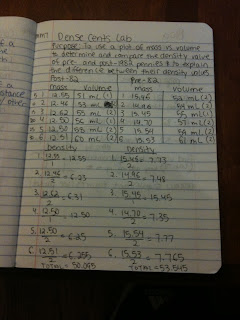
After we did our review and notes, Mr. H explained Lab MM7. The lab was called Dense Cents Lab and the question was “What is the density value of pre- and post-1982 pennies? How do their density values compare? How can the difference be explained?” The purpose was to use a plot of mass vs. volume to determine and compare the density value of pre- and post-1982 pennies and to explain the difference between their densities. First each group separated the pennies into two groups, one with pre-82 and one with post-82 pennies.
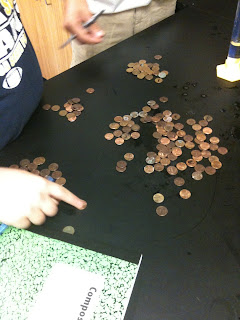

Then we measured out 50 mL of water into a graduated cylinder. This was going to be used to find the volume of the pennies, using displacement. Displacement is where you add the objects to the water and difference between the original volume and the new volume is the volume of the object. We massed the pennies in groups of 5 up to 30. After massing each group of 5 we then put them in the graduated cylinder to find the volume. We then divided the volume from the mass of each set to find the density.

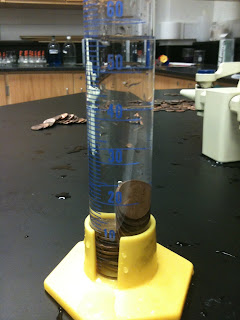


Based on the data that we collected, the pre-82 pennies seem to have a higher density. The pre-82 pennies had a total density of 50.095 and the post-82 pennies had a density of 53.545.


Wednesday, September 15, 2010

Wednesday, September 15

We began today's class by briefly looking at the blog. First, we looked at Konstantine's delayed blog from last Friday (due to technical difficulties, of course) and Katie's blog from last night. Mr. Henderson then proceeded to give us a brief lesson on how to use DropShots with the blog. This link provides the portal to the "Chemistry Classroom" account with the access password being "gbs":
http://www.dropshots.com/chemistryclassroom

While showing the class Katie's blog, Mr. M noticed that Katie had embedded an link with excellent practice into her blog. This reminded him of telling us about the Delicious assignment that we have due on Friday, September 17. He said that Katie's link was a perfect example of what we could use for our assignment. He showed us how to log into the database and how to tag and fill out the form for our links. In order to log into this website, we need a Yahoo account. Mr. H told us that it would be useful to have a Yahoo, Google, or Facebook account because those major corporations would end up taking over many of the smaller companies. Thank you for those wonderful words of wisdom, Mr. H! More thorough directions for Delicious can be found on the hand out we received in class on Monday or on the GBS Chem-Phys website:

http://gbschemphys.com/honchem/index.html

After our tech tutorial, Mr. Henderson asked us to take out our unit packets and turn to page 9. Before beginning the worksheet, he quickly reminded us of the differences between a physical (describing the substance without describing its interaction with other substances) and chemical (describing the substance by how it interacts with other substances) properties. To give us a better idea, he told us he would show us an example of a chemical property of magnesium. He showed us the sample of magnesium - a shiny metal - and turned on the methane flow. He lit the burner (from the bottom up, of course) and began to burn the magnesium. Mr. H told us that magnesium reacted very strongly with oxygen to make magnesium oxide and that we should be prepared to see a very bright light, indicating the reaction. Sure enough, when the magnesium heated up enough, we saw a very bright light. Our experience was similar to this video from Youtube:
http://www.youtube.com/watch?v=Q_LU1EASadU

Mr. H then pulled up an overhead of 4 out of the 5 pieces of evidence of a chemical change. They are: bubbling & production of gas, formation of a solid, heat or light, color changes, or temperature changes. The difference between a heat/light change and a temperature change is that the temperature change is more drastic and long term.

As soon as all the explanation was finished, we began page 9 and the "Verbal Description of Change" section. We attempted to do the section individually and went over the activity together and the answers are as followed: C, P, C, C, C, P, P, C. We had to be on the lookout for the chemical changes we learned about in each of the scenarios order to determine the type of change.

Next, we determined the "Symbolic Description of Change" as a class. If the element remained the same, it was a physical change. If the before and after differed from each other, it was a chemical change. The answers are as followed: P, C, C, P.

To finish the page, we flipped it over and determined the "Visual Depiction of Change at Microscopic Level". We had to be on the lookout for changes in the shape and arrangement of the atoms and molecules. The answers are as followed: C, P, C, P.

Abruptly, Mr. H got up and directed us to the back of the room and under the fume hood. He asked us for two pennies. He took our a large bottle of nitric acid and explained to us what a hazardous chemical it was and how we had to be careful when handling it. Mr. H was going to demo the reaction between copper and this nitric acid. He poured the acid into a flask and diluted it with some water. He dropped one of the pennies in and told us to observe. Meanwhile, he took another flask and filled it with pure nitric acid. He dropped the copper penny into the substance and told us to observe and compare it to the other flask. Immediately, we saw a change of color. The acid went from clear to a gradient green-red. Bright orange gas began spewing out of the top of the beaker. It bubbled and displayed a clear chemical change. The diluted beaker was showing the same changes (minus the color change and significantly less bubbling and gas) at a much slower rate. Mr. H ask Katie to touch the beakers carefully. She told the class they were both very warm, indicating a temperature change. It was very interesting to see the copper penny dissolving and reacting with the acid. The flask with the pure nitric acid and penny looked similar to this photo:

We concluded the class by returning to our seats. Mr. Henderson quickly read us a story about a man whose experience with nitric acid inspired him to keep experimenting with it. With little time left, we were instructed to turn to page 11 and complete the "Verbal Description of Change" and determine the Physical and Chemical properties. The answers are as followed: P, C, C, P, C, P, C, C, P.

Just as the bell was about to ring, Mr. H handed out the quizzes from last week and told us to check our answers and use it as a guide. He told us that tomorrow we could expect a lab about density and that our homework was finishing the 1.2 Webassign and our Delicious assignment.

Friday September 10, 2010

Today's class started off by getting our lab notebooks back. Mr. H graded Labs 1-4, but didn't tell us our grades in our lab notebooks. He told us that he wrote comments and suggestions in most lab books.

Mr. H then had everyone take out their chemistry packets and he went over the question on the bottom of page 6, which was about listing significant numbers when adding, subracting, multiplying, and dividing. He went over significant numbers again and how many to include when adding, subtracting, multiplying, and dividing. The rules are as followed when adding/subrtracting or multiplying/dividing:

Addition/Subraction: The number of decimal places in the result is equal to the number of decimal places in the quantity with the least certainty (i.e., least number of decimal places).

Multiplication/Division: The number of significant figures in the result is the same as that of the quantity with the least number of significant figures.

Mr. H then worked with the class on the first two practice problems to clarify what the rules were saying. He then had us work on the rest of the practice problems by ourselves. After a few minutes of working Mr. H revealed the answers to the class, so everyone was able to check their answers. He answered a few questions from students and then he went to our class's chem blog.

Mr. H went over Hannah's and Neil's blog posts and then gave a few tips on how to make both blogs a bit better for next time.

Mr. H then had the class open up their chemistry packets to the last page to look over today's lab, which was MM6 Conservation of Mass Lab. As the class wrote down the purpose, he explained what we were going to do in today's lab and what to expect. He told the class that since we were going to be dealing with liquids and chemical reactions, that we should wear our safety glasses. He explained to us that we were to find the mass of a flask before the chemical reaction and after, and then compare the differences.


As everone went to their lab stations, they first began by pouring a blue liquid into a flask and then put a testing tube filled with a white substance. Groups then went and measured the flask with all its components as shown below. 


Click to view video.

Groups then returned the their stations, recorded the mass, and then put a cap over the flask, flipped over the flask, and saw the chemical reaction between the white substance and the blue liquid. The result of the chemical reaction was a white solid that formed. Groups then went on to find the mass of the flask with all its components and record their results.

When students finished, they went back to their desks and Mr. H began to pass out scan-trons for our pop quiz. The quiz was only 14 questions, and consisted of the material learned in chapters 1:1-2. The quiz lasted untill the end of class.

Monday, September 13, 2010

Monday, September 13


We started class today with Mr. Henderson telling us to get out our calculators, lab notebooks, packet, and to make sure we had patience. We began class by reviewing Lab MM6, the Conservation of Mass Lab. During this lab, we measured the mass of chemicals before and after a chemical reaction. The purpose was to figure out if mass was retained or changed during a chemical change. One person from each lab group went to the front of the room to record their data so we could see what the overall data of the entire class was. This is what the class data turned out be:


We then discussed whether or not the results of the lab shows that mass is retained during a chemical change. Some people said that mass was lost, since some of the masses decreased lightly. Others said that the mass stayed the same because it only changed slightly. Mr. Henderson told us that the mass had stayed the same. He said that in chemistry, 157.37=157.21. This could be because of the uncertainty or some of the chemicals may have fallen out when it was measured for the second time.


Once we finished reviewing the lab, we started to learn about metric conversions. We were told we had to memorize four of the prefixes. We learned a great way to remember them.


1 kilometer=1000 meter


100 centimeters= 1 meter


1000 millimeters=1 meter


10^9 (1,000,000,000) nanometers=1 meter


We also learned a way to remember the many different prefixes by using a scale.

We learened how to use this scale to do metric conversions. If you wanted to convert a kilometer to a meter, you move the decimal place 3 places to the right since the base unit is 3 spaces to the right of the kilo. If you wanted to convert millimeters to meters, you move the decimal place 3 places to the left since the base unit is 3 units to the left of the milli. We practiced doing this by doing a worksheet, page 7 in the packet.

We then went over problems 7 and 8 form the worksheet. 7 was converting 1 mL to kL. First we learned to convert it to L. If you move the decimal place 3 to the left, you get 0.001 L. If you move that 3 more places to the left, you get 0.000001 kL. for 8, the problem was to convert 1.0 Mg to mg. Mg was not on the scale, but it was listed on the worksheet as 10^6. If you calculate 1.0 X 10^6, you get 1,000,000 g. It still needs to be put into mg from g, so you move the decimal place 3 spaces to the right. The solution to that is 1,000,000,000 mg (10^9 mg).

We finished class by being assigned our homework to do a Webassign reading sheet for tomorrow and our Delicious Assignment, which is due on Friday. Overall, it was a very productive class.

Sunday, September 5, 2010

Friday, September 3, 2010

Todays class period was a rather unique one, but it started off the same as usual before it got interesting. We viewed Emma's blog in which she did an excellent job. Mr. Henderson then explained to us the photo situation. The photos that we would take on his camera for the blog would be on a website called dropshots.com.

We then looked at lab MM4. Separating Mixtures Lab and wrote down the purpose. Mr. Henderson then had us turn to page 18 in our Chemistry Basics packet to learn how we could separate sand, salt, and iron. It said that each method relies on the fact that the components have different physical properties which can be used in separation method.
To show us how this all worked, Mr. Henderson showed us a very fun and original demo. He talked about how sand had many variables in itself and could be split up into rocks, little pebbles, fine sand, and super fine sand. He used different sized screens to split these variables up going from the biggest openings to the smallest. As he started to 'shake it up,' he danced to one of his favorite songs by KC and the Sunshine Band. http://www.youtube.com/watch?v=8GtGY6tuDaA&feature=fvst

After that attention-grabbing demo, our class began the lab by weighing or finding the mass of the mixture by using the zero, or tare button. The mixture consisted of salt, sand, and iron and was a heterogeneous mixture because we could visibly see the differences in the substances. We then had to figure out how to separate them. First, we used a magnet to separate the iron because iron is magnetic. Next, we poured the rest of the mixture into water because we knew that salt was soluble, and we could filter out the sand. This is exactly what we did. We poured the mixture of sand, salt, and water through filter paper and a funnel which left behind the sand.


After that, we put the filter paper with the sand on a hot plate to dry it off. We did this because when we would weigh the sand to figure out its mass, we would not want to have water be part of that mass too.


We then weighed the iron and the sand to find out the mass in grams. To find the mass of the salt we subtracted the weight of iron and sand from the weight of the total mixture. We did this because salt was the only substance remaining so it would have to have the remaining weight of the mixture. For example, if the mixture weighed 2 grams, the iron weighed 0.24 grams, and the sand weighed 0.46 grams, then the salt would have to weigh 1.30 grams because 2 - (0.24+0.46) = 1.30. Furthermore, we calculated the percent of the salt, sand, and iron in the mixture by dividing its weight by the total weight of the mixture and multiplying it by 100. After doing that math, we wrote down our conclusion.

Class time was running out, and the Web Assign homework was assigned. We all left class 'shaking our booties' as Mr. Henderson put the song back on for the last couple minutes of class.

Thursday, September 2, 2010

Thursday, September 2, 2010

Today was a rather average day in Chemistry Class. Mr. Henderson began by taking attendance and then going over the blog post done by Dmitriy from the previous day. Mr. Henderson then explained our homework due Tuesday more thoroughly. The homework was a 1.1 WebAssign on the Classifications of Matter. Mr. Henderson explained how the questions worked and how for some questions you received multiple chances to get them correct.
We then moved on to pages 1 and 2 in our Unit 1 packets. Page 1 and the first half of page 2 were about the symbolic language of mixtures. For the first group we were given a drawing of a substance and asked how many types of atoms were in it and how many types of compounds were in it. Then in part 2 we were given a diagram of the substance, and the symbol for it. We were then asked to describe the substance using words like atom, compound, molecule, element, etc...

The bottom half of page 2 was about the interpretation of mixtures. We were given long symbols for a substance and were asked how maybe elements and compounds there were, as well as the total number of atoms and the total number of molecules. This part was the most difficult for the class to understand.

We finished class up with Lab MM3 or the Salt, Sand, and Iron Lab. The purpose of the lab was to distinguish between salt, sand, and iron on the basis of their physical characteristics. We began by just observing the three substances and recording their color, granular size, and texture. Next we tested each of the item's magnetic properties by moving a magnet over each and seeing how it reacted. My lab group discovered that only iron had magnetic properties and that they were very strong. Next we tested the solubility in water of each substance by adding a little bit of each to a test tube of water and mixing it around. My group found that only salt dissolved in the water and the other two just sunk to the bottom.

Class today was very fun and very educational. The lab was a great way to test properties and it was great to have more practice on the types of matter.

Tuesday, August 31, 2010

Monday, August 30


Today in class, we started the day off by discussing the blog. He showed us the seating chart that also shows when our blog dates are, so we could remember which day we were going. Then Mr. H detailed how to log in, and how to format our posts. He proceeded to described to us how we also have to put tags in our posts, and how to put in pictures.

The next part of class today was the lecture. The lecture consisted of Mr. H telling us about Atoms, Molecules, Elements, and Compounds. He Explained how Matter consists of particles, and these particles can be individual atoms, or molecules (multiple atoms attached to each other). He also told us how atoms are elements, and that each one has it's own name ans symbol. The last part of the lecture was about how atoms can exist individually, combined with multiples of the same atom, or bonded to different types of atoms.

To finish off the day, We had a lab to do. This lab involved mixing calcium chloride, sodium bicarbonate, 5 mL of an aqueous solution, and phenol red indicator in different combinations. The groups started off by mixing all of the substances together. This produced a red liquid inside of the bag, and the bag started to inflate! This shows that the reaction was producing some sort of gas.


The next test involved mixing Calcium Chloride with the Sodium Bicarbonate. This produced no reaction for my group. Also, my group failed to complete the last part of the lab, and therefore we have no data for the last part.

Today was a very interesting day in our chemistry classroom. We learned much of the basics of chemistry, and we did a very cool lab in addition to that. I think we all had fun today.