Tuesday, April 19
Class started off today by Mr. H taking tardies for people who were late (Hannah). He then told us to get out our lab notebooks and write the title and purpose of the lab we will be doing later in the period; Ksp Lab.
After we finished this up, we took a look at Tim's blog from last night which was really classic. "Also, due to the reasons I forgot, the test on Wednesday will be pushed back to Thursday." The wise words of Tim Joo. Anyway, he talked about ICE and some of the Ksp problems which are located on pages 17-19 and 24-25.
Today's lesson focused on continuing with the Ksp problems and learning how to solve for Ksp by using solubility values. The first problem we did was on page 25, problem d. I'm not going to go over it in great detail because we already learned about and I think it is a pretty straightforward topic to understand. But if you want to know the correct answer it is [Cu2+]= 2.29*10^-7 M and [OH-]= 4.58*10^-7 M.
We then moved on to page 26 where Mr. H explained what molar solubility is; a partially souble salt's number of moles which dissolve per liter of aqueous solution. The first problem we solved was 8a and the answer was Ksp= 1.17*10^-10.
Then, we went over to page 27 to solve 8b.
The first step is to write the balanced equation which is Fe(OH)3(s) <---> Fe3+(aq) + 3 OH-(aq). Next, you need to fill out the ICE table. The initial amount for both of these products is 0 because you are given 0 amount of them. The change for Fe3+ is +x because we don't know what the change is and there is no coefficient in front of it. For OH-, the change is +3X because there are 3 moles of OH for every one mole of Fe. The equilibrium amount for Fe is x and 3x for OH. You then have to write the Ksp expression which is Ksp= [Fe3+] [OH-]3, and OH is to the third power because you have to switch the coefficient to a power. but it only matters if the coefficient is greater than 1. After this, you plug in x and 3x for the products values; x*(3x)^3= 27x^4. For x, plug in 1.01*10^-10 and the equation is Ksp= 27*(1.01*10^-10)^4. Finally the last step is to calculate and solve for Ksp= 2.81*10^-39.
After we finished the math portion of the day, Mr. H started off the lab by explaining what we needed to do to complete this lab. The rest of the period everyone worked on the lab.
Homework: Test on Thursday and Lab Notebooks due Thursday.
Showing posts with label KyleK. Show all posts
Showing posts with label KyleK. Show all posts
Tuesday, April 19, 2011

Tuesday, September 21, 2010
Tuesday, September 21
Mr. H started off class by telling us to turn our lab notebooks in with our lab rubric in them. He also reminded us that our test is on Thursday and our 1.3 Density WebAssign is due tomorrow. We then looked at Brooke's blog which was filled with useful information about the test. After this, Mr. H told us toady we would review for the test and then finish our Beverage Lab. He then showed us that he added our Delicious bookmarks to the blog as resources to study for the upcoming test. However, some peoples' bookmarks aren't on the page, so Mr. H told us to check to see if we have the right tags: hcp3y1011 and unit 1, or the Delicious website isn't functioning properly.
Mr. H then told us to get out our review packet and turn to page 19 which was the density reading sheet. Since we had already gone over problems 1-6, we only went over problems 7-14. The answers for these problems are:
7. C; temperature
8. A; increases
9. B; 63 degrees
10. B; 35 grams
11. B; they absorb certain colors of light and reflect the rest to our eyes.
12. D; bluish-green
13. D; 820nm
14. C; reddish-orange
Mr. H told us while we were writing down the answers that these types of questions would be on our ACT. Some questions would be easier like question 7, while questions like 14 would be more challenging.
After we wrote our answers down, Mr. H reviewed temperature and accuracy vs. precision. The three major temperature scales are: Fahrenheit, Celsius and Kelvin. The formulas for finding temperatures are: *F=1.8*C+32, *C=(*F-32)/1.8 and K=273.15+*C. The boiling point of these temperatures are: 212*F, 100*C and 373.15K. The freezing point are: 32*F, 0*C and 273.15K. For additional reference, use page 8 of the book. Mr. H showed us a picture of three dartboards with one portraying inaccu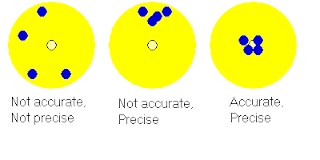 rate and imprecise throws, the other portraying accurate, but imprecise throws, and the last one portraying both accurate and precise throws. Here is a picture relating to this idea.
 rate and imprecise throws, the other portraying accurate, but imprecise throws, and the last one portraying both accurate and precise throws. Here is a picture relating to this idea.
 After this, Mr. H reviewed the classifications of matter on page 16. The answers are as follows:
A. HOM
B. HEM
C. E/C
D. HEM
E. HOM
A. C
B. E
C. C
D. HOM
E. HOM
F. HOM
G. HEM
H. HEM
I. HEM
J. HOM
A. F
B. F
C. F
D. T
E. F
F. T
G. F
Some key classification of matter terms are element, compound, homogeneous mixtures and heterogeneous mixtures.
Element- Type of matter that cannot be broken down into two or more pure substances. Ex. Oxygen
Compound- A pure substance that contains more than one element. Ex. Water is a compound of oxygen and hydrogen.
Homogeneous mixture- The composition is the same throughout, also known as a solution. Ex. brass is a homogeneous mixture of zinc and copper.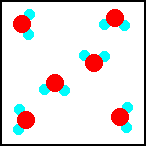

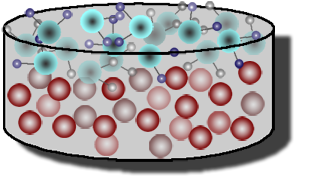
Heterogeneous mixture- The composition varies throughout. Ex. Granite contains discrete regions of different mixtures (feldspar, mica, and quartz).

After we finished reviewing, Mr. H told us to finish our Beverage Lab. Two group members of each group went to the computer lab to graph the data while the other group members found and recorded the data of two beverages. My group chose apple juice and berry juice. The volume was 5mL for both juices and the mass ranged between 0.75g and 1.15g. The density of apple juice and berry juice was between 0.15 and 0.23 g/mL.
Once we finished, Mr. H told us to write a Conclusion/Discussion for the lab and make sure we had the graph attached to the data sheet. He also said if your group didn't finish, finish it and hand it in at the start of class tomorrow.
Subscribe to:
Posts (Atom)