Showing posts with label density. Show all posts

Tuesday, September 21, 2010

Monday, September 20

Today Mr. Henderson started the day out by signing up the remainder of people for blog days if they have not already done the blogging. He then goes on to tell our class that today we will be doing a lab test. The lab test will be done throughout today and tomorrow.

Homework: Labs #5, 6, and 7 are due Tuesday (tomorrow)
webassign is due Wednesday
TEST THURSDAY

FOR THE TEST, STUDY FROM THE BLOG, TEXTBOOK, AND OBJECTIVE SHEET FOUND IN THE UNIT PACKET.

A sheet was then handed out explaining what should be included in the labs which will be turned in tomorrow.

Mr. Henderson then began to explain what our class is going to be doing for the rest of the week. Tomorrow we will continue working on the sugar lab and then have a lab test. Then we will review for the test Thursday. Wednesday we will be starting to learn about the next unit. Thursday is the test and on Friday first someone from the TLC will be coming to talk to our class and then we will be going to the computer lab.

Next Mr. Henderson told our class to take out our Chemistry Basics packet while he opened Anthony's blog from the previous day (Friday). After looking at the blog we turned to page 13 in our packets and worked on problem #5, which said if a piece of aluminum has a mass of 14.0 g, what volume does it occupy?(the density of aluminum=2.70 g/cm cubed). To find the answer, Mr. Henderson set up the equation volume=mass/density=14.0g/2.70g per cm cubed. The answer when put into the calculator came out to be 5.185185185185. Using the significant digits rule the answer is 5.19 cm cubed. We also learned the answer could be 5.19 mL because cm cubed equals mL.

The next problem we did was #11 on page #14. The question was several beads of an unknown metal are placed into a partially-filled graduated cylinder. The water level in the graduated rises from 24.58 mL to 49.12 mL. The mass of the beads was determined to be 127.88 g. Determine the density of the metal. To solve the problem Mr. Henderson set up the equation density=mass/volume=127.88g/24.54mL. The volume was found by subtracting 49.12-24.58=24.54 mL. 127.88g/24.54mL=5.21108. Using the significant figures rule the answer is 5.211g per mL.

Once we finished the 2 problems Mr. Henderson went on to tell us that for our test on Thursday that we will have to know how to do the percent difference(difference between the 2 measures/average of the 2 measure x 100) and find the density of a substance(density=mass/volume).

Then it was time to start the lab for the day. Mr.Henderson explained that the purpose of the lab is to determine the percent sugar in each of the beverages. What percent of the beverage is sugar? The reason why we would want to know this is because sugar contributes to the mass. The beverages used are made mostly of water and sugar but also flavorings and dies.

Today we did the first part of the lab which was finding the mass and volume of water that had either 0%, 5%, 10%, 15% or 20% of sugar in it. These measurements would be used to determine the amount of sugar in the beverages which would be tested tomorrow. Mr. Henderson then reminded our class to wear our safety goggles and to dispose of the sugar water in the sink. Also he then explained how to use the pipets by turning the wheel.

In the lab, as expected, it was found that the more sugar the water contained, the higher its mass. The mass of the 0% sugar water was 4.97g, 5% was 5.03g, 10% was 5.07g, 15% was 5.16g, and the 20% was 5.25g. The volume of the 5 substances was a constant 5.00 mL.

This is a picture of my lab group’s data table from lab #8

This is a picture of the rubric which will used to grade the labs.


Saturday, September 18, 2010

Friday, September 17

On Friday the first thing that Mr. Henderson asked the class to do was pull out their Unit 1 Packets and a calculator. He then told the class that we would not be staying here long, we would be going to the computer lab to do some graphing and plotting on a program called Graphical Analysis. Mr. Henderson then took attendance and we started to admire Lindsays very well set up blog post of the day before. Mr. Henderson notices that there is a link to a page with some practice for significant digits. He tells the class that for later blogs if we decided to add a link to our blog we could use that same link for our Delicious assignments.
After we had finished admiring Lindsays
blog it was time to get down to business and take a look at page 13 in our unit packets which had some density practice for us. On the page we
needed to know the formula for density which is, Density = Mass/Volume. It also talks about how the units of density are usually expressed in grams/ml or grams/ cubed centimeters. We then do problems 4 and 5. In problem 4 the density is given as 8.933 g/ cubed cm and the mass is 2.62 g. we have to find the volume of the substance so we use the equation for density and plug in the numbers we know, 8.933 = 2.62/x, in order to solve this problem we will have to use algebra. Start be multiplying both sides by 1/2.62 then we get the answer .293295, this is not the answer because we have not put significant digits into consideration yet. since we
divided we use the same amount of digits of the number with the smallest amount of significant digits which would be 2.62 which has 3. So our final answer for this problem would be .293 cubed cm.
We then go to page 14 of our packets and it is similar to what we do in the computer lab. In the computer lab we plot the volume and mass that is given on page 15 and a graph is made. Then because we have to plot our data from the Dense Cents lab, we plot our information from the Pre 82 and 82 coins and the Post 82 coins.
For homework we had to do 2 webassign assignments, finish labs 5, 6,and 7, because we would be getting them checked on tuesday, and finally we have a unit 1 test on thursday.

Thursday, September 16, 2010

Thursday, September 16

We started off today’s class by going over last nights blog, done by Alex P. Mr. H then continued on to talk about the expectations for Lab MM5, which was to make sure you wrote a couple of paragraphs describing the chemical reactions of the substances you tested. Mr. H took a few minutes to review the five pieces of evidence that characterize chemical change, which were evolution of gas, solid being formed, production of heat or light, change in color, and temperature change. Next Mr. H started our lesson on density. We went over the Chapter 1.3 reading sheet (page 21) and took some notes on density in the margin.

NOTES FROM CLASS DISCUSSION:

The big idea was that every substance has a unique set of identifying properties; these properties distinguish the substance from other substances. For example: Water is a colorless substance that boils at 100 degrees C, freezes at 0 degrees C, has a density of 1.0 g/mL and a heat capacity of 4.18 J/gC.

· Intensive vs. Extensive Properties

o Intensive- identifying does not depend on amount

o Extensive- (usually volume and mass) depends on amount

· Chemical Properties: describes how a substance reacts (or not) with other substances

· Physical Properties: describes a substance apart from how it reacts

· Three common physical properties: density, solubility, and color

· DENSITY

o A measure of how tightly that mass is packed into a given volume of space

o Density= mass/volume

o Units: g/cm^3, g/mL, kg/L, kg/mL

After Mr. H explained density, he went through the answers to the 1.3 reading sheet:

1. .A

2. .A. PP, B. CP, C. PP, D. CP

3. .FALSE- The density of a material is specific to that material and not dependent on the amount.

4. .A

5. .D

6. B

7. .C

8. .A

Mr. H noticed that many people didn’t understand how to do number 4, which involves knowledge of significant digits. If you still don’t understand or would like to practice it more then you should go to this website or see packet page 6: http://www.physics.uoguelph.ca/tutorials/sig_fig/SIG_dig.htm

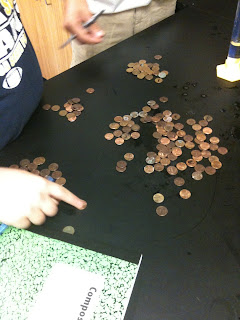
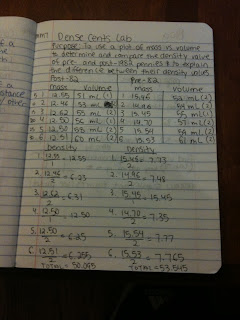
After we did our review and notes, Mr. H explained Lab MM7. The lab was called Dense Cents Lab and the question was “What is the density value of pre- and post-1982 pennies? How do their density values compare? How can the difference be explained?” The purpose was to use a plot of mass vs. volume to determine and compare the density value of pre- and post-1982 pennies and to explain the difference between their densities. First each group separated the pennies into two groups, one with pre-82 and one with post-82 pennies.


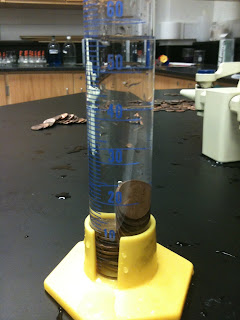
Then we measured out 50 mL of water into a graduated cylinder. This was going to be used to find the volume of the pennies, using displacement. Displacement is where you add the objects to the water and difference between the original volume and the new volume is the volume of the object. We massed the pennies in groups of 5 up to 30. After massing each group of 5 we then put them in the graduated cylinder to find the volume. We then divided the volume from the mass of each set to find the density.


Based on the data that we collected, the pre-82 pennies seem to have a higher density. The pre-82 pennies had a total density of 50.095 and the post-82 pennies had a density of 53.545.