Showing posts with label unit4. Show all posts

Wednesday, November 10, 2010

Monday, November 8

Mr. Henderson started class today by examining what the rest of this week looks like. We will be learning a new topic for the next couple of days preceding the test, followed by the test Friday. He told us that the test Friday will be composed of: 14 multiple choice questions, 1 double-sided page of writing and balancing equations, no math work, and a section on identifying the reaction type. Mr. H said that what is going to make this test difficult is that it requires a lot of unit 2 work -- writing equations and such. But, we have a very resourceful tool to help us review, this blog! Mr. H walked us through Brooke's blog and talked about how helpful it will be to study for the test. To review, we can also use the Delicious websites created by the class (which, reminder, are due on Thursday!).

We then moved on to the new topic of today, Dissociation and Hydration. He begun this by doing page 11 in our packets. The first small section of this page was identifying a compound as being either ionic or molecular. An ionic compound is one which consists of a cation (metal) and anion (nonmetal), while a molecular compound consist of, normally, two anions. A good, common example of a molecular compound are those hydrocarbons Mr. H keeps talking about. These are the answers to the first part of page 11 ("i" for ionic and "m" for molecular):

1.
a. NaCl I
b. CO2 M
c. NaNO3 I
d. D2H5OH M
e. NH4Cl I
f. C6H12O6 M

If you need extra help distinguishing between the two types of compounds, this is very helpful: http://www.buzzle.com/articles/ionic-compounds-vs-molecular-compounds.html

The following section of the packet introduces a new topic to us, dissociation/hydration. We were supposed to find what the compound looked like after it had dissolved in water (after being broken up into individual ions by the water). The first few problems/answers are:

a. KF(s) -> K+(aq) + F-(aq)
b. CaCl2(s) -> Ca2+(aq) + 2Cl(aq)
c. Na2SO4(s) -> 2Na+(aq) + SO42-(aq)

One of the most difficult things to remember is that Uncle HONClBrIF does not apply to these ions because they're not considered to be "by themselves", but "with" water.

As should be obvious by now, all we are doing is splitting the compound into the ions of which it is made up. But then it gets a little more trickey; we are asked to perform the same type of equation, they give us the name and expect us to derive the formula from that. For example the first question asks what happens when you put lithium phosphate in water:

First, we figure out that the formula for lithium phosphate is Li3PO4
Next, we figure out that the ions of which it is mad up are Li+ and PO43-
Then, we balance the equation to get something which looks like this -- Li3PO4(s) -> 3Li+ + PO43-

After doing a couple more problems like this one, we moved onto yet another new topic. This is the topic of electrolytic (E) and non-electrolytic (NE) solutions. What makes a solution electrolytic is if it is created by ionic compounds, a cation and an anion.
Answers to the last section:

a. NaCl E
b. SO3 NE
c. C2H5OH NE
d. KF E
e. BaCl2 E
f. C12H22O11 NE

He demonstrated this concept through a conductivity test. If, when the wires were placed in the solution, it caused the lightbulb to light, then the solution is electrolytic. This also implies that it contains an ionic compound. He used a video (from the blog) to demonstrate this:

http://g.web.umkc.edu/gounevt/Animations/Animations211/StrongWeakNonElelytes.swf

After this, we moved on to Lab CR2, the Chemical Dropout Lab. We mixed various substances, observing whether or not they each created a precipitate. If a solid developed, or the mixture became cloudy, we knew that a precipitate had been formed.

This picture shows perfectly what precipitates look like.

Overall, today was a very intense day. We were introduced to many new concepts, but luckily Mr. Henderson is explaining them very well and we have many review tools at our fingertips.

Sunday, October 31, 2010

Friday, October 29

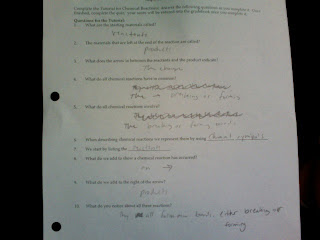
This Friday we got our Unit 3 tests and our first quarter grades. We went over the test and then Mr. Henderson explained to us that the computer took off three of our worst webassign homework grades. There seemed to have been a problem, so he said that he would fix it once we went to the science computer lab. Once we got into the science computer lab we had to get with our qroups and exchange our information and work for the flight crash problems. Mr. Henderson said that if groups finished early they could start on the homework which was a Chemthink on chemical reactions. First we had to look at the tutorial to get the idea of the subject. Then we had to take a quiz on the material we just learned. You could only get 2 wrong. If you got three wrong you had to start over. mr. Henderson also told us a bout a work sheet on the back of the new packet that would be due with the Chemthink. The page has a front and a back side to it. An easy way to get it done would be, going through the tutorial and writing in the answers as you follow.
The basics of what we will be learning about in this unit is that the starting materials are called reactants, the materials that are created are called the products. You know that there has been a change when there is an arrow in between the two. This is just a little from the chemthink. There is a lot more to it than this. But I will let you figure that out for yourself.

Saturday, October 30, 2010

Thursday, October 28

Thursday was test day. We took the Unit 3 test with 15 multiple choice questions, a page of short calculations and a page of longer calculations.  This day marks the official end of Unit 3.


Unit 4 will begin on Friday. Unit 4 is concerned with the topic of chemical reactions. We will learn what a chemical reaction involves and how different reactions can be characterized based upon their features. We will also learn how to use atom counting as a means of balancing chemical equations via the trial and error method. The unit will end as we focus upon precipitation reactions and learn to predict what precipitate will form as two aqueous solutions of ionic compounds are mixed. There will be virtually no mathematics in this unit. There will be a lot of symbolic representations.