Showing posts with label heterogeneous. Show all posts

Tuesday, September 21, 2010

Tuesday, September 21

Mr. H started off class by telling us to turn our lab notebooks in with our lab rubric in them. He also reminded us that our test is on Thursday and our 1.3 Density WebAssign is due tomorrow. We then looked at Brooke's blog which was filled with useful information about the test. After this, Mr. H told us toady we would review for the test and then finish our Beverage Lab. He then showed us that he added our Delicious bookmarks to the blog as resources to study for the upcoming test. However, some peoples' bookmarks aren't on the page, so Mr. H told us to check to see if we have the right tags: hcp3y1011 and unit 1, or the Delicious website isn't functioning properly.

Mr. H then told us to get out our review packet and turn to page 19 which was the density reading sheet. Since we had already gone over problems 1-6, we only went over problems 7-14. The answers for these problems are:

7. C; temperature


8. A; increases


9. B; 63 degrees


10. B; 35 grams


11. B; they absorb certain colors of light and reflect the rest to our eyes.


12. D; bluish-green


13. D; 820nm


14. C; reddish-orange


Mr. H told us while we were writing down the answers that these types of questions would be on our ACT. Some questions would be easier like question 7, while questions like 14 would be more challenging.

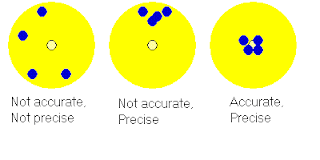
After we wrote our answers down, Mr. H reviewed temperature and accuracy vs. precision. The three major temperature scales are: Fahrenheit, Celsius and Kelvin. The formulas for finding temperatures are: *F=1.8*C+32, *C=(*F-32)/1.8 and K=273.15+*C. The boiling point of these temperatures are: 212*F, 100*C and 373.15K. The freezing point are: 32*F, 0*C and 273.15K. For additional reference, use page 8 of the book. Mr. H showed us a picture of three dartboards with one portraying inaccurate and imprecise throws, the other portraying accurate, but imprecise throws, and the last one portraying both accurate and precise throws. Here is a picture relating to this idea.


After this, Mr. H reviewed the classifications of matter on page 16. The answers are as follows:

A. HOM


B. HEM


C. E/C


D. HEM


E. HOM


A. C


B. E


C. C


D. HOM


E. HOM


F. HOM


G. HEM


H. HEM


I. HEM


J. HOM


A. F


B. F


C. F


D. T


E. F


F. T


G. F


Some key classification of matter terms are element, compound, homogeneous mixtures and heterogeneous mixtures.


Element- Type of matter that cannot be broken down into two or more pure substances. Ex. Oxygen

Compound- A pure substance that contains more than one element. Ex. Water is a compound of oxygen and hydrogen.

Homogeneous mixture- The composition is the same throughout, also known as a solution. Ex. brass is a homogeneous mixture of zinc and copper.
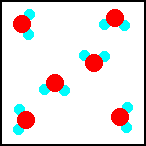
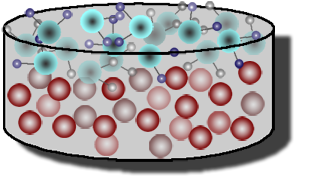
Heterogeneous mixture- The composition varies throughout. Ex. Granite contains discrete regions of different mixtures (feldspar, mica, and quartz).


After we finished reviewing, Mr. H told us to finish our Beverage Lab. Two group members of each group went to the computer lab to graph the data while the other group members found and recorded the data of two beverages. My group chose apple juice and berry juice. The volume was 5mL for both juices and the mass ranged between 0.75g and 1.15g. The density of apple juice and berry juice was between 0.15 and 0.23 g/mL.
Once we finished, Mr. H told us to write a Conclusion/Discussion for the lab and make sure we had the graph attached to the data sheet. He also said if your group didn't finish, finish it and hand it in at the start of class tomorrow.


Sunday, September 5, 2010

Friday, September 3, 2010

Todays class period was a rather unique one, but it started off the same as usual before it got interesting. We viewed Emma's blog in which she did an excellent job. Mr. Henderson then explained to us the photo situation. The photos that we would take on his camera for the blog would be on a website called dropshots.com.

We then looked at lab MM4. Separating Mixtures Lab and wrote down the purpose. Mr. Henderson then had us turn to page 18 in our Chemistry Basics packet to learn how we could separate sand, salt, and iron. It said that each method relies on the fact that the components have different physical properties which can be used in separation method.
To show us how this all worked, Mr. Henderson showed us a very fun and original demo. He talked about how sand had many variables in itself and could be split up into rocks, little pebbles, fine sand, and super fine sand. He used different sized screens to split these variables up going from the biggest openings to the smallest. As he started to 'shake it up,' he danced to one of his favorite songs by KC and the Sunshine Band. http://www.youtube.com/watch?v=8GtGY6tuDaA&feature=fvst

After that attention-grabbing demo, our class began the lab by weighing or finding the mass of the mixture by using the zero, or tare button. The mixture consisted of salt, sand, and iron and was a heterogeneous mixture because we could visibly see the differences in the substances. We then had to figure out how to separate them. First, we used a magnet to separate the iron because iron is magnetic. Next, we poured the rest of the mixture into water because we knew that salt was soluble, and we could filter out the sand. This is exactly what we did. We poured the mixture of sand, salt, and water through filter paper and a funnel which left behind the sand.


After that, we put the filter paper with the sand on a hot plate to dry it off. We did this because when we would weigh the sand to figure out its mass, we would not want to have water be part of that mass too.


We then weighed the iron and the sand to find out the mass in grams. To find the mass of the salt we subtracted the weight of iron and sand from the weight of the total mixture. We did this because salt was the only substance remaining so it would have to have the remaining weight of the mixture. For example, if the mixture weighed 2 grams, the iron weighed 0.24 grams, and the sand weighed 0.46 grams, then the salt would have to weigh 1.30 grams because 2 - (0.24+0.46) = 1.30. Furthermore, we calculated the percent of the salt, sand, and iron in the mixture by dividing its weight by the total weight of the mixture and multiplying it by 100. After doing that math, we wrote down our conclusion.

Class time was running out, and the Web Assign homework was assigned. We all left class 'shaking our booties' as Mr. Henderson put the song back on for the last couple minutes of class.