Showing posts with label compound. Show all posts

Tuesday, September 21, 2010

Tuesday, September 21

Mr. H started off class by telling us to turn our lab notebooks in with our lab rubric in them. He also reminded us that our test is on Thursday and our 1.3 Density WebAssign is due tomorrow. We then looked at Brooke's blog which was filled with useful information about the test. After this, Mr. H told us toady we would review for the test and then finish our Beverage Lab. He then showed us that he added our Delicious bookmarks to the blog as resources to study for the upcoming test. However, some peoples' bookmarks aren't on the page, so Mr. H told us to check to see if we have the right tags: hcp3y1011 and unit 1, or the Delicious website isn't functioning properly.

Mr. H then told us to get out our review packet and turn to page 19 which was the density reading sheet. Since we had already gone over problems 1-6, we only went over problems 7-14. The answers for these problems are:

7. C; temperature


8. A; increases


9. B; 63 degrees


10. B; 35 grams


11. B; they absorb certain colors of light and reflect the rest to our eyes.


12. D; bluish-green


13. D; 820nm


14. C; reddish-orange


Mr. H told us while we were writing down the answers that these types of questions would be on our ACT. Some questions would be easier like question 7, while questions like 14 would be more challenging.

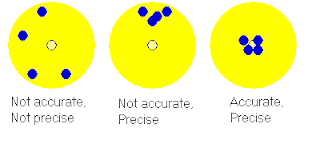
After we wrote our answers down, Mr. H reviewed temperature and accuracy vs. precision. The three major temperature scales are: Fahrenheit, Celsius and Kelvin. The formulas for finding temperatures are: *F=1.8*C+32, *C=(*F-32)/1.8 and K=273.15+*C. The boiling point of these temperatures are: 212*F, 100*C and 373.15K. The freezing point are: 32*F, 0*C and 273.15K. For additional reference, use page 8 of the book. Mr. H showed us a picture of three dartboards with one portraying inaccurate and imprecise throws, the other portraying accurate, but imprecise throws, and the last one portraying both accurate and precise throws. Here is a picture relating to this idea.


After this, Mr. H reviewed the classifications of matter on page 16. The answers are as follows:

A. HOM


B. HEM


C. E/C


D. HEM


E. HOM


A. C


B. E


C. C


D. HOM


E. HOM


F. HOM


G. HEM


H. HEM


I. HEM


J. HOM


A. F


B. F


C. F


D. T


E. F


F. T


G. F


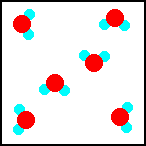
Some key classification of matter terms are element, compound, homogeneous mixtures and heterogeneous mixtures.


Element- Type of matter that cannot be broken down into two or more pure substances. Ex. Oxygen

Compound- A pure substance that contains more than one element. Ex. Water is a compound of oxygen and hydrogen.

Homogeneous mixture- The composition is the same throughout, also known as a solution. Ex. brass is a homogeneous mixture of zinc and copper.
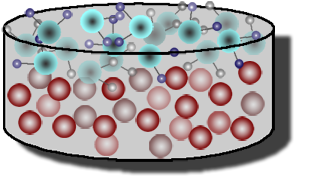
Heterogeneous mixture- The composition varies throughout. Ex. Granite contains discrete regions of different mixtures (feldspar, mica, and quartz).


After we finished reviewing, Mr. H told us to finish our Beverage Lab. Two group members of each group went to the computer lab to graph the data while the other group members found and recorded the data of two beverages. My group chose apple juice and berry juice. The volume was 5mL for both juices and the mass ranged between 0.75g and 1.15g. The density of apple juice and berry juice was between 0.15 and 0.23 g/mL.
Once we finished, Mr. H told us to write a Conclusion/Discussion for the lab and make sure we had the graph attached to the data sheet. He also said if your group didn't finish, finish it and hand it in at the start of class tomorrow.




Thursday, September 2, 2010

Thursday, September 2, 2010

Today was a rather average day in Chemistry Class. Mr. Henderson began by taking attendance and then going over the blog post done by Dmitriy from the previous day. Mr. Henderson then explained our homework due Tuesday more thoroughly. The homework was a 1.1 WebAssign on the Classifications of Matter. Mr. Henderson explained how the questions worked and how for some questions you received multiple chances to get them correct.
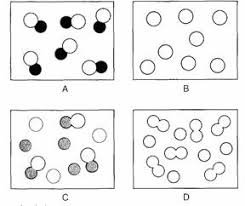
We then moved on to pages 1 and 2 in our Unit 1 packets. Page 1 and the first half of page 2 were about the symbolic language of mixtures. For the first group we were given a drawing of a substance and asked how many types of atoms were in it and how many types of compounds were in it. Then in part 2 we were given a diagram of the substance, and the symbol for it. We were then asked to describe the substance using words like atom, compound, molecule, element, etc...

The bottom half of page 2 was about the interpretation of mixtures. We were given long symbols for a substance and were asked how maybe elements and compounds there were, as well as the total number of atoms and the total number of molecules. This part was the most difficult for the class to understand.

We finished class up with Lab MM3 or the Salt, Sand, and Iron Lab. The purpose of the lab was to distinguish between salt, sand, and iron on the basis of their physical characteristics. We began by just observing the three substances and recording their color, granular size, and texture. Next we tested each of the item's magnetic properties by moving a magnet over each and seeing how it reacted. My lab group discovered that only iron had magnetic properties and that they were very strong. Next we tested the solubility in water of each substance by adding a little bit of each to a test tube of water and mixing it around. My group found that only salt dissolved in the water and the other two just sunk to the bottom.

Class today was very fun and very educational. The lab was a great way to test properties and it was great to have more practice on the types of matter.

Wednesday, September 1, 2010

Wednesday, September 1, 2010


Today's chemistry class was educational, yet different from day to day events. The large, red thing I have above this text is an illustration of a water molecule. H2O - the large hydrogen atom in the center, and the two oxygen atoms on the outside. But this isn't just any ordinary chem "mumbo jumbo"; we performed an exercise in class today based on molecules such as this one.

At the beginning of class, we completed the preliminaries. We discussed Shidan's blog entry, and Mr. Henderson stated we are to be doing a computer activity that day. Entering Room 339, we started immediately.

To begin our work, we proceeded to log on to our computers. Next, we all created ChemThink accounts like Mr. Henderson has shown us in the class. After this, we proceeded through an "atom tutorial". In this tutorial, we learned about certain terms. Included were: pure substance, solution, mixture, atom, molecule, element, and compound. These will be discussed in later paragraphs.

For example, a solution would be much like the water molecule above. It is a compound that fits together nice and smoothly. All the atoms blend into a common molecule. A mixture is different. A mixture contains many different particles, but they do not fuse together in one convenient molecule. Our own drinking water is filtered through the process of distillation; as many non-water particles get taken out as possible.

In the tutorial, we also learned the definition of atoms and molecules. An atom is the basic building block of matter. Everything in existence is composed of atoms. Every element on the periodic table is composed of a single type of atom. A molecule is a series of atoms bonded together. A molecule may be a compound, different elements together, or you could even have a molecule of the same element (a pure substance).

After passing the tutorial, the class took a small quiz on the content. It was necessary to pass the quiz by answering ten questions correctly without getting three wrong in a row. The students could have taken this quiz an unlimited amount of times.

The homework besides that was to complete pages 3-4 in our packet. It was basically a review of what we had studied earlier that day. We had to illustrate atoms and molecules based on their chemical formulas. The pages tested us on whether or not we could distinguish between a solution, a mixture, or a pure substance.

To summarize, our period 3 chemistry class had a productive day today. I personally found the activity very interactive and fun. I may now say I have learned at least something about atoms and their chemical properties.

Blog written by Dmitriy Kalin

Picture taken from Wikimedia Commons


Tuesday, August 31, 2010

August 31, 2010

Class today started with Mr. Henderson speaking on the subject of our blogging. We viewed the blog posted by Will and Mr. H spoke on logging into the blogging site with our school email.

Then we reviewed our homework in our unit 1 packet. Our homework was on chapter 1.1 of our textbook on the subject of types of matter. But before we got to look at the answers, Mr. Henderson covered them and reviewed some key terms and points of the section first. Some of these points were the learning progression of our year in chemistry, which will hopefully end with us being enlightened on the subject. We also reviewed some key terms such as matter, a mixture and a compound. After the review, we finally checked our work.

After reviewing our homework, the class turned to page 2 of our packet. Then Mr. Henderson helped us fill in the chart were we identified whether the drawing was showing an element or a compound, and if it consists of atoms or molecules. The class learned that if a substance is made up of only one type of matter it was an element, and if a substance is made up of different types matter it was a compound. Also if a substance is a compound then it only consists of molecules. But if a substance is an element then it can be made up of either atoms or molecules. As Mr. Henderson was teaching he was always referring to the giant periodic table on the wall to help get us a more visual idea of what makes an element an element. Then the rest of the page was assigned for homework.
The rest of class was dedicated to us finishing our Observation and Experimentation Lab. In this lab we were supposed to observe the changes which occurred when we mixed the chemicals calcium chloride, sodium bicarbonate, and a solution of phenol red indicator. When the chemicals were mixed some of the different mixing of chemicals had reactions such as the inflation of the bag which showed fumes were released, the bag getting hot, and/or a color change. Then time ran out and the rest of the lab was assigned for homework.
Today's fifty minutes of class was very educational and productive.

Monday, August 30


Today in class, we started the day off by discussing the blog. He showed us the seating chart that also shows when our blog dates are, so we could remember which day we were going. Then Mr. H detailed how to log in, and how to format our posts. He proceeded to described to us how we also have to put tags in our posts, and how to put in pictures.

The next part of class today was the lecture. The lecture consisted of Mr. H telling us about Atoms, Molecules, Elements, and Compounds. He Explained how Matter consists of particles, and these particles can be individual atoms, or molecules (multiple atoms attached to each other). He also told us how atoms are elements, and that each one has it's own name ans symbol. The last part of the lecture was about how atoms can exist individually, combined with multiples of the same atom, or bonded to different types of atoms.

To finish off the day, We had a lab to do. This lab involved mixing calcium chloride, sodium bicarbonate, 5 mL of an aqueous solution, and phenol red indicator in different combinations. The groups started off by mixing all of the substances together. This produced a red liquid inside of the bag, and the bag started to inflate! This shows that the reaction was producing some sort of gas.


The next test involved mixing Calcium Chloride with the Sodium Bicarbonate. This produced no reaction for my group. Also, my group failed to complete the last part of the lab, and therefore we have no data for the last part.

Today was a very interesting day in our chemistry classroom. We learned much of the basics of chemistry, and we did a very cool lab in addition to that. I think we all had fun today.